

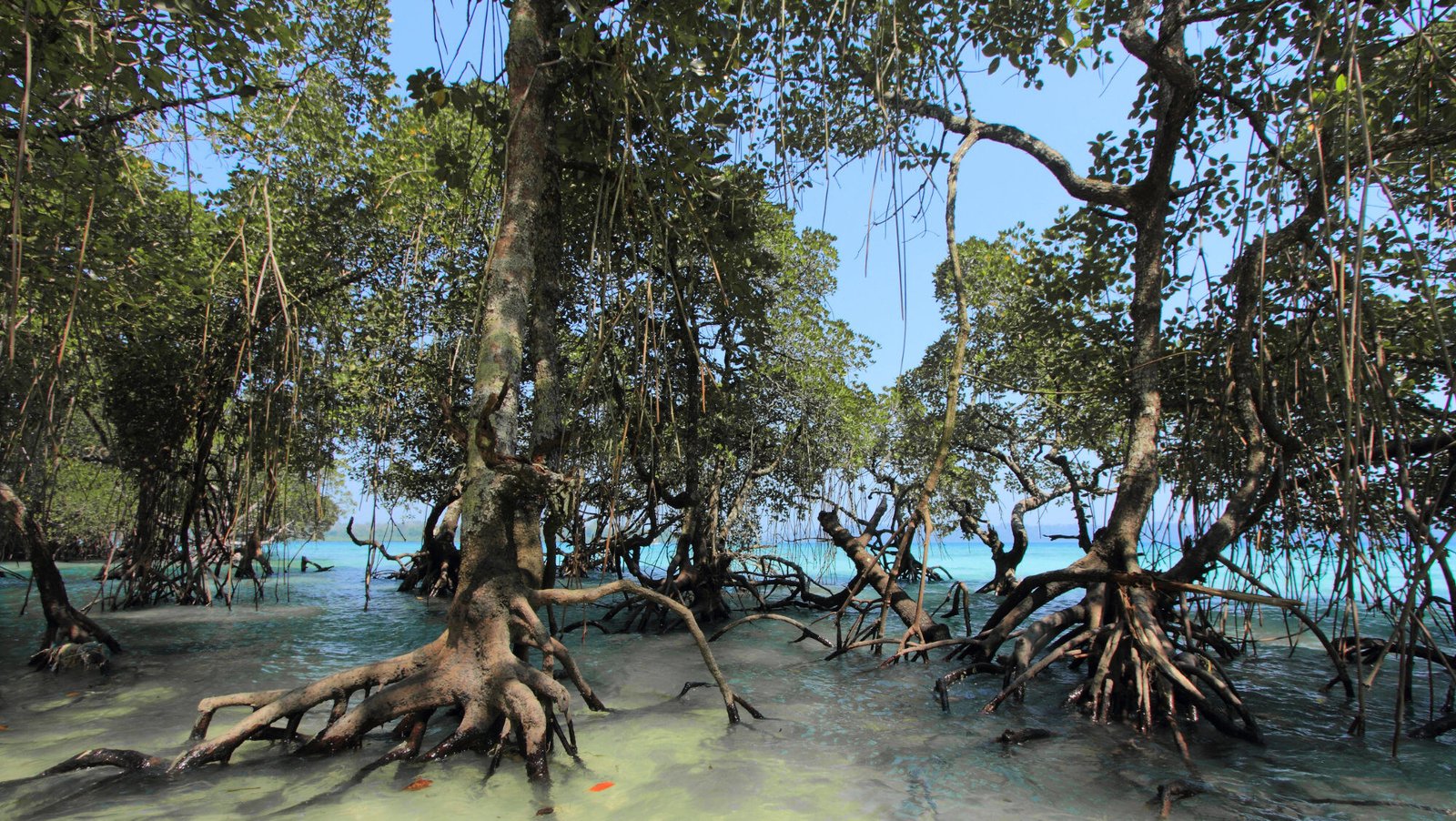
Bordering the quiet western boundary of Rising Tide Landing lies a place where land and water negotiate constantly. Residents know it as Lanternroot Hammock, a dense mangrove forest shaped by tide, freshwater seep, and the slow patience of coastal time.
A narrow creek flows into the hammock from nearby Star Cradle Spring, carrying cold, mineral-bright water beneath arching mangrove roots before fading into the darker brackish lagoon. Along this winding corridor, sunlight fractures into shifting patterns, and the air holds the layered scents of salt, peat, and green growth.
Lanternroot Hammock is not a manicured nature trail. It is a working ecosystem — protective, intricate, and quietly beautiful.
Red mangroves stand closest to the water, their prop roots forming natural archways and sheltered nurseries for marine life. Behind them, black mangroves rise on knuckled root systems, their salt-dusted leaves clicking softly in the wind. Farther inland, white mangroves and buttonwood trees create pockets of higher ground where the forest floor feels almost dry beneath drifting shells and wind-borne seeds.
Wildlife thrives in this layered environment.
Visitors may spot great blue herons, snowy egrets, and roseate spoonbills stalking the shallows at low tide. Schools of juvenile snapper and tarpon flicker through the tannin-dark creek water, while small mangrove crabs scuttle across exposed roots. On quiet mornings, the soft exhale of a West Indian manatee may be heard near the lagoon edge, and during migration seasons the canopy fills with warblers and ospreys riding thermals overhead.
More elusive residents leave subtler signs — the narrow slide of a water snake into the current, raccoon tracks pressed into wet sand, the sudden rustle of a marsh rabbit disappearing into buttonwood shade.
Lanternroot Hammock also serves an important role in protecting Rising Tide Landing itself. Its tangled root systems stabilize shoreline soil, buffer storm surge, and filter sediment from incoming tides. During heavy weather, park residents often walk the hammock’s edge at a respectful distance, gauging wind direction and listening to how the forest responds.
Despite its ecological importance, the hammock has become something more within the park’s shared culture.
Many longtime guests describe the area as deeply calming — a place where conversation lowers naturally and footsteps grow careful. The filtered light at dusk can take on a lantern-like glow as reflections ripple through suspended roots, giving the forest its locally beloved name.
Visitors are welcome to explore designated footpaths and observation clearings. Closed sections help protect nesting areas and fragile root systems, and we encourage guests to move slowly, remain on marked routes, and allow wildlife the space it needs to thrive.
Lanternroot Hammock rewards those who take the time to notice it.
Stand still long enough, and you may discover that the forest is never truly quiet — only patient.